Showing posts with label personal development. Show all posts

Friday, 15 March 2019

What I do for Procurement Teams


Whilst I do work in the personal development arena, I also do a lot of coaching with Procurement teams – especially for larger organisations.

In this vlog I share a little more about the soft skills coaching I can provide to Procurement teams.


Monday, 27 March 2017

Why all maps are wrong

Understanding the following concept 17 years ago resulted in my stakeholders saying I was easier to deal with - and me thinking they were!
The world map is a great analogy that demonstrates what we're doing all the time when we're developing our own world view & beliefs.

The video explores different projections of the Earth and mirrors what we're doing every day of our lives - making our own projection of what we see, hear, feel and understand, and storing that map believing it to be the truest projection available.

It's no wonder misunderstandings occur when we realise we're all using different projections.

17 years ago understanding that how I saw the world was only my projection/perception of it meant the words and tone I used changed, and as a result made my communication easier to hear. No longer where people told that my world view was right. Instead a world view was offered for them to make sense of from their own world view. Common ground was then found, and relationships much more harmonious as a result.

Alison Smith
The Purchasing Coach
Unlocking procurement potential often using unconventional tools

Communication is one of the postcards included in the Purchasing Coach Soft Skills Toolkit that brings together a series of postcards from your soft skills - it's entitled Dear Procurement, with love from your soft skills. More here.


Tuesday, 26 January 2016

Where's change management?

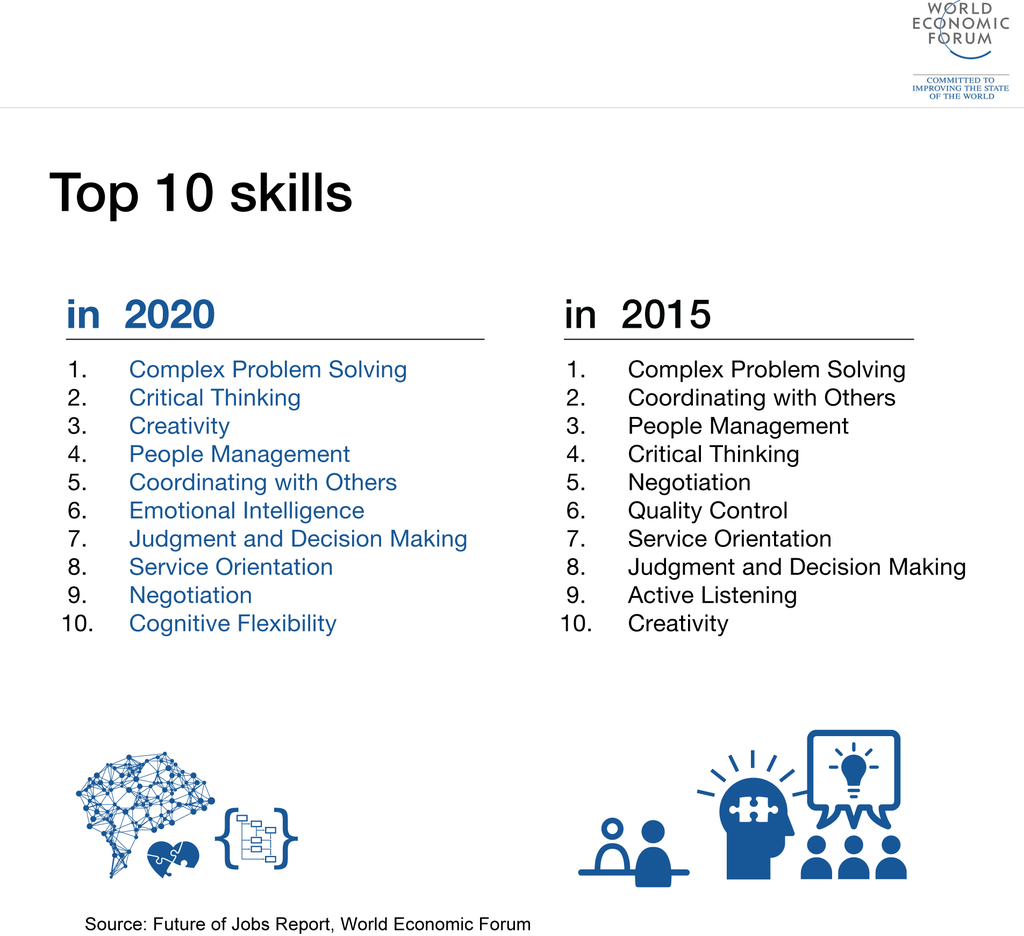
Yesterday I saw this image in the Huffington post 

Whilst searching for "top 10 skills for 2020" other lists emerged, not unsurprisingly suggesting other skills may also be important. I particularly liked this list from Top 10 online colleges


A believe a common enabler to implementing these skills has been omitted from both of these lists, and other's I visited, and that is managing change.

That is sustained change, required to develop and use these new skills, is only possible if hearts and mind's are engaged and that doesn't just happen. It requires that we be motivated to make the changes and, as I said yesterday, that requires that people be inspired - inside and out.

So before you start developing these skills, or recruiting for this *new* skill set, do make sure you understand how change will be embraced by these individuals, and how it will be managed and inspired going forward.

I'm attending #MentalHealthAtWork in Glasgow tomorrow, and was reminded by the notes from the last conference that 'reaction to change' is a major cause of stress. So too excessive demands, ineffective relationships and lack of: clarity on roles, control, and support. It's interesting, or perhaps I should say disturbing therefore, that skills to manage these didn't more significantly make it into the top 10!

What skills do you think will be in the top 10 for 2020, and where do you think change management (or even stress management) fits in?

You may also like Allison Ford-Langstaff's series of posts over on Future Purchasing's site that looks a little further ahead and ask's - what will procurement look like in 100 years time. Although my suggestion that we may no longer have any money never made it into any of her 3 lists - the seriously good, the disturbingly bad nor the slightly mad!

I've written other blogs on the enablers for team working, supplier management and category management because learning what to do differently, just as for any of the skills above, won't happen unless the enablers are in place.  No surprise that change management was included - so too many behaviours that would reduce the stressors mentioned in the last #MentalHealthAtWork conference. I'll be writing a blog following this year's conference - so watch this space.

Alison Smith
The Purchasing Coach
Inspiring change inside and out

Monday, 2 November 2015

Reasons to be angry part 2 - mirrors

Last week I said I'd explore another source of anger and so here it is - reasons to be angry part 2 *
Anger comes in many shapes and sizes, and its sources are as numerous. That said we each have a choice what emotion we respond to another person with. In other words:
  • It is not true to say that a person's behaviour made us angry.
  • It is true to say we chose to be angry as a result of the other person's behaviour.
A subtle difference, and yet one that changes the responsibility for the anger from the other person to us. Something we often don't like to take responsibility for - preferring instead to continue to blame the other person.

When we feel anger it certainly feels as if our anger is justified - of course we believe we're right to be angry about the person doing this, saying that, or not doing something else. However consider these 2 different reasons for anger:
  • Anger that is appropriate, and ensures we take action to distance ourselves from the source of the unacceptable behaviour. That is situations where most people would agree with us about the unacceptableness of the other persons actions. These situations are often supported by the law, codes of conduct and ethics, or human rights.   
  • Anger that arises when one of our buttons has been pressed - ie other people might not necessarily agree with us about the unacceptableness of the other person's actions. 
It's this latter form of anger I want to explore.

Last week I discussed the situation where our anger arises from compromised values. That is we value a behaviour so much we get angry when other people don't meet our expectations in that regard.

Today I want to look at anger when its source is the disowned parts of us that we see in other people.

I'm sure we can all recall times when someone has said of another "they're so arrogant" or "rude","selfish", "lazy", "critical", "aggressive", "dishonest", "competitive" and so on - when our response to them would ideally be "and so are you".

The key is remembering if we can say "and so are you" when someone judges another person - then the same can be said of us. That is we too can judge other people simply because it's a fault we don't accept in ourselves. The key to recognising this is happening is that anger or irritation is often involved.

Consider the following list and rank the level of anger/irritation (0/10) you feel when people demonstrate the behaviour:
  • Arrogant
  • Rude
  • Selfish
  • Lazy
  • Critical
  • Aggressive
  • Dishonest
  • Competitive
  • Controlling
  • Passive
  • Manipulative 
  • Talkative
  • Negative
  • Positive
  • Unethical
  • Resistant
  • Analytical
  • Uncompassionate
  • Apathetic
If non of these have pressed your buttons then write your own list of what behaviours do press your buttons and that illicit an angry / irritated response. To do this you may want to remember when you've been irritated with someone, and identify the behaviour they were demonstrating that triggered your reaction.

For any of the higher scoring behaviours you may want to consider if any of the following are true:
  • Does everyone agree with your assessment of the other person's behaviour? and if you say yes - are you sure? and what evidence do you have? (When we get angry, and there's no budging us on our opinion, others may find it difficult to disagree with us and simply just nod, or change the subject, believing quite rightly, its easier to acquiesce than disagree.)
  • Are you irritated every time everyone demonstrates this behaviour or just some people - what's the difference between those whose behaviour you accept, and those that you get angry about?
  • Do you get angry when you demonstrate this behaviour - and what excuses differences are there between you demonstrating the behaviour and other people?
  • Is the behaviour compromising a value you have?
  • Is this a behaviour you perhaps need to learn how to do more of - for example we could get angry about someone being selfish because a part of us knows we need to learn how to think of ourselves more than others sometimes.
  • Is this a behaviour you demonstrate that you don't like nor accept in yourself.
The clue we're onto something useful for this last point is the discomfort we feel when we 'agree' we too can be seen by others to demonstrate, some of the time, some aspects of, that behaviour - but we don't like it. 

Another clue we're disowning that part is the ease with which we can run down the rest of the list and say "yes I can be like that sometimes" with no emotion nor discomfort accompanying the statement.

Yet when we get to a disowned behaviour we resist acknowledging that this behaviour is also a part of our repertoire. We get uncomfortable and try to qualify our behaviour.

To take the anger out of our judgement of others requires us to own, acknowledge and appreciate that behaviour in ourselves. Oddly as it sounds it's this ownership that takes the heat our of our own behaviour - it's as if when we don't own it - the behaviour controls us. As soon as we own it we have choice about how we demonstrate the behaviour - enabling us to utilise all its best qualities rather than only show its more challenging sides. 

Easier said than done and may include considering one or all of the following:
  • The benefits to be gained from that behaviour (e.g. we may resist selfishness because we can't see any benefits from doing it)? or what's the positive energy behind the behaviour?
  • What other terms can be used to describe this behaviour (e.g selfishness might be described as having courage, supporting well being, assertiveness, ensuring sustainability and survival. Another way to get at the benefits)?
  • How can you demonstrate this behaviour more usefully?
  • What situations does this behaviour come up in for you - with specific people, in specific places, in reaction to specific behaviours? 
  • How does, or has, this behaviour set you back in the past - ie think of a specific instance (sometimes we're holding on to a specific event, and therefore acknowledging the pain (setback) we're still holding on to allows the behaviour to become just like the other behaviours). 
  • How might you deal with these situations differently in the future?
  • What action can you take to no longer be setback by this behaviour (I remember one example where the antidote to superiority was coming in sooner with a solution in meetings rather than holding back in a very superior way. It's certainly easier to identify an antidote if you've identified and described a situation where you've been setback by the behaviour.)  
I'd love to know if you've had any ah-ha's as you've read this.

I realise as I've been writing this that much of the insight shared here have arisen as I've used the Frameworks for change Coaching Process with clients to address many of these sorts of behaviours (see ** below for more on the process). If you're interested in finding out more about the coaching I do please call me +44 (0)7770 538159 or email alison@alisonsmith.eu

Alison Smith
Inspiring change inside and out

* Every time I read 'Reasons to be angry part 2' I think of Ian and the Blockheads Reasons to be Cheerful part 3 and remember seeing them at the Victoria Hall, Stoke on Trent in 1978! Oh dear - with my birthday approaching - that does make me feel old!

** Frameworks for change coaching process (FCP)

I've been successfully using the FCP in my coaching and group facilitation work with clients since 2005
  • FCP - applied to improving relationships at work
  • Youtube - a playlist with a couple of video blogs on the subject

*** I do like Johnhain's pictures (as shown above) and found in Pixabay - I've used his images a few times on this blog. I must buy him a coffee very soon.

Thursday, 1 October 2015

NLP - does it work

 
I like a challenge, and as I have a few hours before my plane leaves Amsterdam, I have decided to use that time to reply to Rob Briner's post asking about the evidence for NLP. 

I'd suggest the question is flawed - it's assuming NLP is something that we can define - something we all have a common understanding about that we can put in a wheelbarrow and investigate.  

However I see NLP as something similar to purchasing, HR, gardening or dancing. That is - a catch all title that doesn't necessarily tell you what competencies, tools, techniques or outcomes anyone is using or getting from doing that activity. I personally put the techniques I learnt on the NLP workshops in the personal development or soft skills category rather than using NLP.

I don't know the research behind dancing, and in fact I would suggest I don't even know what the outcome we think dancing is meeting. I know I enjoy it, and I know I personally get benefit from doing it and watching it. That's enough evidence for me. 

There's lots of varieties of dance, and when millions sit down to watch Strictly Come Dancing on Saturday evening they're not wondering what research has been undertaken for its efficacy. 

Everyone watching Strictly will have a different viewpoint about the benefits they get from watching, and what benefits those taking part obtain. If they don't enjoy watching it they simply turn it off - friends may try to convince them of the error of their ways but they're hardly going to be persuaded to watch by someone showing them a research paper on the benefits of vicarious dance watching. Alternatively millions of people enjoying it won't be persuaded by other research demonstrating how TV watching is bad for them.

That is the Strictly watchers, and non watchers alike, use their personal experience to determine the efficacy of their experience. That experience will then determine whether they continue to choose to experience it.

If I want to get fitter, learn to dance, relax, become more supple or flexible, laugh out loud, or simply spend time with friends there will be a multitude of dance classes, nightclubs (are they still called that?) or DVDs I can use to support me in achieving that outcome. 

To decide which of these different classes we take we will each need different data/evidence.
  • One person may need to try it for themselves and if they have a good experience believe it works
  • Another may need to try it 5 times until they believe it's effective 
  • Someone else may need to know someone who has benefited 
  • Or know 10 people who have benefited 
  • Or know someone in authority who has found it works 
  • Or only know it's effective if their friend believes it 
  • Or read a book on the subject 
  • Or they may need to know why it works
  • Or understand the underlying theory or process it uses 
  • Or see the research that supports why it works
We're all different - the above list provides 10 different means of obtaining evidence. What we each mean by the word 'evidence' is therefore different. My evidence, is not your evidence, is not another person's evidence. There is certainly evidence for the efficacy of all NLP techniques just not the evidence some would like.

I can't persuade someone who wants the research paper that something works based on my experience, in the same way someone else wont be able to persuade me that my experience is invalid because of the lack of a research paper. In the same way that, just because someone only believes in something's efficacy because a professor said so, doesn't mean I'm going to discount my own experience. (Best not muddy the water further with exploring the fact that we often get what we look for in life which presupposes nothing is fact :-)) 

Yes there will be dance DVDs and classes making extraordinary claims but they're the minority and certainly won't be used to judge all dance classes. Why expect the same from those using NLP techniques in their work. It's why I use personal development as the term to describe the tools I use - too many people have chunked their experience of 1 NLP tool or practitioner to mean it applies to all NLP tools and practitioners. Something we don't do when we look for dance, soft skills, communication or influencing experts. 

I don't know what research has been done on every NLP technique - similarly I don't know what research has been done for dancing. I don't know why people haven't tried to justify each of the NLP tool's existence or efficacy. I don't know who would pay for this, and the motivation behind doing it. The things I read about where research is funded seem to be where $billions are involved to counter the nay sayers in order to protect the profit e.g. pharma, FMCG, car emissions and so on - and look where research got them. 

(I'm not saying research isn't valid I'm just saying that for me my own experience will have a higher priority than someone else's research because I trust myself more. That said if someone provides their evidence I will explore it to see if my own criteria may be flawed, or in need of change. After that we may agree to disagree  - we're simply choosing to work from a different map of the world).

I also don't know the research for the category management tools and techniques, supplier management techniques or HR techniques I use every day - but I still use them. 360 degree feedback was all the rage some time ago and now I'm reading it's going out of favour. Did research determine when it was the flavour of the month, and it is now determining it's decline? I don't know - although the research itself doesn't necessarily change someone's good or bad experience of 360 feedback. 

What I do know is since attending an NLP workshop I understand myself better, and therefore as a result can flex my behaviour more easily to adapt to situations and people. The tools I use the most, with myself and others, I use frequently because they work (for me and my clients) eg well formed outcomes, eliciting values, beliefs, use of metaphor, rapport, language, anchoring **, standing in their shoes. 

I'm sad Rob if you want to know the research before you try out a technique (although now I check your occupation I can understand it's the foundation of what you do). For me that would provide me with a lot of stress because it would impact so many aspects of my life and stop me making any decisions or taking action! 

I saw someone do something really well today, and at the next opportunity I will be trying it out myself. I don't need to know what research supports its efficacy - I experienced the words for myself and will see what outcome I get. If it works I may do it again, and I may even tell others. (That said I'd word it as 'this worked for me why not try it yourself' rather than saying "having tried it once I now think it's a miracle cure".)

For me that's what modelling is all about - and NLP started out as 2 academics researching how people did what they did well so others could try it for themselves. The tools aren't something new and were around before someone decided to give put them in a NLP toolkit - they're things people, who do things well, do - so watch 2 people in rapport and you'll be able to learn what rapport is. Yes I learnt this on an NLP workshop - but if prompted you could learn it on a bus or in the pub too. Most things I learn in conversation with others in the pub I don't feel the need to rush to find the research - I may buy a book but I'm assuming that's not what you'd accept as evidence Rob? The lack of research certainly wouldn't stop me trying them out and then sharing it in my work if I found they worked for me. 

Your very question Rob is the essence of what NLP workshops have taught me - we're all different, we're motivated by different things, react differently, have different convincer strategies. What is right for me may not be right for you - it doesn't mean we're either right or wrong - it's just how we make sense of our world. 

I'm sorry I can't give you what you need to know - I'd love to be able to give you the research that proves that a number of NLP techniques are fabulous tools - just because I can't doesn't mean they're not fabulous tools for some people. 

Ok best go through security - see you on the other side ;-) 

** just a thought - anchoring is based on Pavlov's research (ie the guy with the dogs, bell and dog food) and is the basis behind the phobia technique I was taught. That is a stimulus causes a reaction and you can exchange that negative reaction with a more positive one. ie use the same mechanism that you developed the phobia in the first place to make it less intense. It's not magic but may feel like that to someone who has had a phobia for years and no longer has it. The key to getting the technique right is ensuring you understand the stimulus - for a spider it could be seeing it, or it moving, or its legs or something else entirely. Until you understand the stimulus that triggers the reaction Pavlov's theory isn't going to be of any use at all! We've taught ourselves how to be scared for years and we can teach ourselves not to be - someone just decided to put it in the NLP toolkit.

Tuesday, 24 March 2015

EQ Summit (The leader's mind and its potential)


I attended the EQ summit in London last week and these are just my notes for future reference with links to other blogs/YouTube clips, and other references relating to the content and speakers.

I share it here for ease, and in case anyone else is interested too.

Although please note this is the conference seen through my filters - others attending may have taken something totally different away from the sessions.


So why all the fuss about EQ?

Leaders with EQ:
  • Bring out the best in others
  • Super charge the capability in the organisation and unlock 'discretionary' effort
  • Go with the human grain not against it
  • Have people working for them who are 3 times as likely to stay
  • Achieve extraordinary things as a result

The main sponsors/organisers and joint developers of the emotional capital report (ECR)
  • Roche Martin
  • Sheffield Hallam University
  • Sheffield Business School
10 elements of the emotional capital report, and therefore the building blocks of EQ are:
  • Self reliance
  • Straightforwardness 
  • Optimism 
  • Self actualisation
  • Self confidence
  • Self knowing
  • Relationship skills
  • Adaptability
  • Self Control
  • Empathy
With excellent graphic facilitation from @simonheath1 - whose website can be found here and also wrote a pre summit summary of who would be talking, and did a great job of selling the event (Simon was the only reason I found out about the event).


The Speakers

Welcome - Amy Bernstein - editor at HBR


Emotional Capital - the asset on the balance sheet you can't afford to ignore - Dr Martyn Newman - author and MD at RocheMartin
  • A great summary of a similar talk by Martyn, and a wonderfully animated video too, Emotional Capitalist - the new leaders.
  • Emotional Capitalists - the ultimate guide to developing emotional intelligence for leaders - Martyn's book on the subject
  • "We are profoundly connected to others and influenced by them"
  • He told a great story about Apple's business success over Sony - due to Apple's ability to collaborate and work together, and Sony's lack of emotional capital. Something I'm sure Sony regret to this day. 
  • Firms of endearment - a book on how world class companies profit from passion and purpose
  • Understanding values of ourselves and others is key (ie our motivators)
  • "What ever you find (when you look at yourself) you have to like"
"What lies before us and what lies behind us 
are but small matter compared to what lies within us. 
And when we bring what is within us into the world, 
miracles happen!" 


Better self, better leadership, better business
Jeremy Darroch - Sky CEO
  • "EQ potential super charges the capability we have and unlocks 'discretionary' effort"
  • CIPD article from the session - Empathy is the top leadership skill says SKY CEO 
  • "EQ delivers a high performing environment - rejects complacency and embraces the new"


Grant Thornton - leadership EQ's impact on revenue
Breakout with Anne Blackie and Jenny Kidby

Programme to introduce EQ across the business to move from technical experts offering solutions (often short term) to transformational leaders co-creating solutions (longer term too).

That is put the expert's ego to one side and bring our wholeness to work (the emotional and real person).


Motivation, performance and purpose
Dan Pink - author
  • "Reward of carrot and/or stick is outdated for the 21st century"
  • "3 main motivators - autonomy, mastery and purpose"
  • "Mastery - making progress in meaningful work" 
  • "Purpose - Making a contribution or difference"
  • "When asked 'tell me about your best boss' you never hear 'pathologically controlling' in the answer"
  • HBR article on purpose/how/why - trying to find what my notes meant on this - will come back when I know more, and if you can shed any light I'd much appreciate comments below - thank you
  • "Aim to tell people 2 less 'how's and 2 more 'why's" (links to the last comment)
  • "The profit motive can be an engine for good"
  • "You can go against the human grain, or with it"
  • Dan Pink's talk has been animated by RSA see 'Drive - the surprising truth about what motivates us', also his book on the same subject and HBR article.
  • Sukh Pabial's blog on the talk - Motivation, Dan Pink and EQ


Mindfulness for leaders
B Alan Wallace

Those that know me would expect me to already be into mindfulness and meditation. It's certainly the language I'm comfortable with. After all I've seen the Dalai Lama speak, and I even have the headspace app on my phone (even if I've hardly used it). 

However this is the first time I have EVER understood the benefit of mindfulness practices!  

The premise is - mindfulness helps focus attention at the same time as retaining a sense of ease. Which means after achieving this state of mindfulness we don't get stressed or strained when we do what we do afterwards. How wonderful is that!!

Or put another way - all our busyness, over attention or even boredom will stress our mind and body and therefore mean we're less effective - its also unsustainable for any period.


The alchemy of empathy - transforming stress into meaning
Eve Ekman
  • "There's a correlation between a lack of feeling of emotion in our body and lack of empathy with others"
  • "It's about emotional regulation"
  • Here's a video of a similar talk by Eve at the Mind and it's potential conference - cultivating emotional balance at work

Why the future begins - using EQ to optimise the future
Magnus Lindkvist

Sorry the last train north (and yes I mean very much north of Watford) was calling so I didn't hear Magnus speak. Tweets suggested he finished the day very humorously but I couldn't find any blogs or vlogs to link to - any suggestions most welcome.


As I made links to the content and my own passions I tweeted links to a few of my blogs:

Hope you found this helpful - I know I'll be back when I'm trying to recall what someone said, or to find that YouTube vlog.

Alison

Alison Smith
Inspiring change inside and out

I  did suggest on twitter half way through the session that this collage depicts life without EQ - ie without our humanness!


Wednesday, 14 January 2015

The case for soft skills

 
I was excited to read a BBC news article this morning that said:
 
"Soft skills" need to be taken much more seriously as factors for business success, says a campaign by employers.
 
I could write at length about the use of the term 'soft skills' to describe skills such as "communication, initiative, interacting with customers and team working" but that's for another blog. Although I have written a blog for those thinking "but I don't do soft skills".
 
I can certainly say that when I was first immersed in soft skills training 15 years ago my business life changed for the better. There's isn't a day goes by that I don't use these skills even if it's just to remind myself that how I see the world isn't how others do. Which is why I love the graphic above. A visual reminder that we're all different.
 
What this appreciation of our different world views does is takes out the tone from our language - the tone that says "I'm right and don't need to listen to you" and replaces it with a tone that says "My understanding of the situation is this - what's yours".
 
I use the next graphic, and when delivering workshops actually act this out, to demonstrate that if you keep doing what you've always done to someone you may never open the door to mutual understanding ie you don't push someone when they need to be pulled - or more specifically you don't give someone a detailed report if they'd prefer and take more meaning from a one page visual. 
 
 
The reaction I often get when coaching, facilitating or training this subject is "Why do I need to adapt my style to other people".
It's as if people think they'll lose their identity if they don't express themselves exactly as they'd like to.

My response is always the same "you don't need to change anything if what you're doing is working - if you're happy with the current state of affairs then keep doing what you're doing."

Over the 15 years there have been many responses to my use of 'soft skills' in the procurement training we deliver and more generally in my blogs. What I have noticed in the last 6 months is a step change on attitude. A move away from "it's manipulative" towards one that appreciates that its adoption can open many closed doors. Whether those closed doors are to:
  • understanding
  • success
  • change
  • appreciation
  • results
  • collaboration
  • team working
  • and so on
Of course you might just see soft skills as fluffy and not want to go near them with a barge pole in which case you might want to read my blog on my response to "But I don't do soft skills".

Before Christmas I wrote a blog exploring this subject more fully and it has been one of my most popular blogs since starting. This interest provided the inspiration to write more broadly on the subject covering such topics as Trust, Change Management, Taking Responsibility, State Management, Creativity and Kindness. This month I've also covered Values, Goals and even shared a great process involving Standing in the other person's shoes.

Happy for any suggestions for future blogs or questions on the subject of soft skills development - either below in comments or to alison@thepurchasingcoach.co.uk or +44 (0)7770 538159

Alison Smith
Inspiring change inside and out - when what you're doing isn't working

The coaching and facilitation I offer is specifically aimed at identifying what it holding you or your team back from achieving your objectives including understanding all aspects of these soft skills. More here on the type of coaching I offer, and more specifically when someone else might be the more ideal coach for you.

Friday, 9 January 2015

"I don't do soft fluffy stuff"


Walk the talk Alison and wait till you calm down.

No I'm just going to type away and apologise ahead of time if the tone gets in the way of the message - I'm angry........


A reaction I sometimes get when I explain about the coaching I do, or perhaps more appropriately the tools I use is: 

"oh I don't do fluffy stuff"

Or even worse

"well yes I get the relevance of the work you do but it's just too fluffy for those I work with"

You see - whether we think they're fluffy or not we do all do this stuff. When saying you don't do fluffy stuff you might as well be saying "I'm not a human". In other words unless you're an android, you do have:
  • A body with certain needs to keep it functioning
  • A mind that works in a particular way
  • Emotions that impact you every minute of every day
  • Values that determine your every action (and these come from - dare I say it - your heart!)
  • Beliefs that support these values in all the judgements you make
  • Memories that impact how you behave
  • Skills that you learned in your own specific way
  • Behaviours that push, or otherwise, other people's buttons
All of these come with you where ever you go and cannot, I repeat can not, get left at the door when you walk into work - they're with you 24/7 365 every year of your life.

Actually I've changed my mind - it seems we're a lot like androids with:
  • A specification we were built to
  • Specific memory that can get overloaded  
  • Different operating programmes
  • Software programmes that ensure we function
  • Maintenance schedules to keep us operating efficiently
  • A need for reprogramming and upgrades
  • and yet still crash occasionally with the need for the helpdesk 
The difference between androids and humans are obviously many. However the main one of relevance here is whilst androids have a helpful operating manual - humans don't. Although many of the NLP, emotional intelligence and personality typing theories and models (you know the fluffy stuff above) would go some way to providing input into developing your own personal operating manual.

The challenge when we're not succeeding is we do really need to understand our own operating manual.

Of course we can try to emulate the likes of the the Dragons, Richard Branson or Arianne Huffington but we don't have their memories, experiences, mind, body or emotions. So whilst we can model what they do we will need to understand how that can be translated into our own operating language.

"There's plenty of people out there who don't do this fluffy stuff"

Great and if you can do that and succeed, and achieve what you want from life - then as they say "fill your boots". But let's get this clear - you may not know about the fluffy stuff - but since bicentennial
man is a long way away - you are still doing the fluffy stuff - you can't help but not do.

This blog isn't about saying everyone has to learn everything about this 'fluffy stuff'. However it helps to acknowledge that is does have baring on what you do every minute of every day.

As the over used saying goes:

"If you keep doing what you've always done you'll get what you've always got"

In other words if you're not succeeding then change what you're doing. Of course you can do this without understanding or looking at your operating manual (yes the fluffy) but it is a little more hit and miss. If you get out your operating manual then you can really start to understand why you're not getting the results you want.

Ignoring the "fluff" when you're stuck is like:
  • Getting the plumber to cut your hair
  • Knowing your car keys are in your coat pocket and looking everywhere else for them
  • Putting your chicken in the fridge and expecting it to roast
  • Putting diesel in your petrol car and blaming the car
  • Buying a ticket to London when your meeting is in Edinburgh
  • Arranging the meeting for Wednesday and turning up on Thursday
"It's everyone else fault I'm not getting what I want"

No it's not and you know it - even if it is only that inner voice (sorry is that too fluffy) that knows it.

That's right the fluffy stuff can help answer why you're not moving forward in the direction you want. Of course goal setting will help and all the other things I've blogged about this month. If you've tried that, however, and are still not getting where you wanted something else is stopping you.

I hate to say it but the solution is likely to be found right in the middle of all that lovely fluff.

Do you want to know why your fluff has the answer - because *said in a whisper* it could just be one of the following that's getting in your way of results, success and the achievement you've always dreamed of:
  • Your relationships with other people
  • Your arrogance
  • Your bullying behaviour
  • Your lack of confidence
  • Unhelpful beliefs
  • Fear - of success, failure, other people or even flying
  • Overly restrictive values
  • Resistance to change
  • Conflicting values (a biggie)
  • Abuse from others
  • Lack of trust
  • Inability to control your emotions
  • Unhealthy choices
  • Negativity
  • Too much positivity
I'm sorry if that got too fluffy - but that's the reality of being human.

As a result of the life you've lived you are who you are and some of those experiences will have been helpful and others not. We just sometime need a little help from the helpdesk to reprogramme, upgrade or uncorrupt some of our software scripts.

Unless you're happy not achieving your goals of course.

I hope I have persuaded you of the relevance of the fluff even if I would prefer we called it personal development or something like that. The sad reality is most people reading this will agree with me, and already take ownership for exploring the fluff to find what's holding them back. I just hope that a few people out there who usually dis the fluff may have had their minds changed. Happy to have a chat to discuss more fully +44 (0)7770 538159.

Alison Smith
Inspiring change inside and out - when what you're doing isn't working - and yes sometimes just having a rant!

And for the eagle eyed followers of my blog amongst you, yes this was written later in the month and put back here because I didn't want it to get in the flow of blogs on achieving your goals.

Wednesday, 7 January 2015

Why do I have to change?


For much of a recent category and supplier management workshop I was encouraging those there to adapt their style to that of their stakeholder.
 
A common response to this is to say "but why do I have to change - why can't the other person adapt their style to mine."
 
You don't have to change anything if what you're doing is working.
 
I'll say that again.
 
YOU DO NOT HAVE TO DO ANYTHING IF WHAT YOU'RE DOING IS WORKING.
 
The clue is "if it's working".
 
If you have no need to influence the other person ie for them to change, and are happy with the current state of play then don't do anything differently. Simple.
 
If you're not getting the response you want you can either keep doing what you're doing and most likely get the same response, or adapt your style and see if it opens the door to effective communication with that individual.
 
As a result of me learning and applying all these influencing tools my stakeholder said I was easier to deal with. The funny thing was I thought she was easier to deal with. Once I stopped saying things in a certain tonality, and used words that made sense to her not me, and made her feel heard and appreciated our relationship blossomed :-).
 
Of course you don't have to stop being you - to successfully influence others however it is useful to be able to flex your style to suit the environment.
 
Alison Smith
Inspiring Change inside and out - when what you're doing isn't working
 
I'm an associate of Future Purchasing - so for more on the category and supplier management workshops I deliver with them please do visit the website.

For more on the influencing tools I incorporate into the procurement training ( for Future Purchasing and other consultancies) you may want to read this blog on 'how NLP changed my life' (bare with me and read it please) or this one introducing some of the influencing tools.

Wednesday, 31 December 2014

Collage cards

Whilst much of my coaching and facilitation takes places within organisations and more specifically within procurement functions I do also offer personal coaching to those with more personal objectives.

Whilst some of the tools I use can be applied easily in both personal and business settings e.g. frameworks for change or landscaping your life, others are much more suited to just personal coaching e.g. Transformation Game and collage cards. These latter tools however don't generally get much of a voice here on my blog. 
 
I'd like this blog post therefore to be my homage to using collage. When you've read this introduction once then you can return again and again to this post and I will add new collage cards over the months for you to explore on your own.

The premise is: our unconscious often knows the solution to any challenge we may be facing. The problem is we don't always know how to listen, or our conscious doesn't want to hear. Using tools such as the collage cards allows us to tap into our inner wisdom. 
 
It's also very simple.
  • Think of a problem you'd like insight on
  • Then pick a card (see below or there's many on Pinterest on my board or other people's boards)
  • Notice what you notice about the card - if you were the card, or an element of the card, what advice would you give to yourself 
  • How might that advice be applicable to this situation and what action will you take
Example 1:

Think of a problem you'd like insight on: 
Too much to do and don't know how to prioritise that list of to-dos - a bit headless chicken like.
 
Then pick a collage card 

Notice what you notice about the card - if you were the card, or an element of the card, what advice would you give to yourself 
 
Don't worry about the big list of to-dos. It's the very size of the list that's stressing you and meaning you're not able to focus. It's important to choose the one thing that is most obvious and do that until completion. Then focus on the next action that needs doing. That way over time things will get done. Spending time prioritising and worrying isn't getting the actions completed.

How might that advice be applicable to this situation and what action will you take
Just do one thing at a time.
 
 
NB: You may get a completely different insight applying this card to that situation. That's why it's such a great tool. It's not about saying there's one perfect solution to every challenge. It's about allowing your unconscious to speak to you via the card by drawing your attention to certain aspects of it. That is today, with this challenge, you may notice the patterns that mean the solution is X. If you looked at the image again next week the solution might be Y or if you applied it to a different situation the solution might be K. The key is allowing the more creative side of you to enter into communication with you to help you solve the problem. 

There is no right or wrong it's just another tool that can assist you when what you're doing isn't working and you're in need of some inspiration or insight.

I'll add more examples over the coming weeks. 
 
Alison Smith
Inspiring change inside and out - when what you're doing isn't working
 
More can be found here on going on a workshop or to find coaches using collage cards in their work. The workshop I went on is being repeated in Findhorn in May 2015.

Monday, 5 August 2013

"iPhone iphone in my hand who is the fairest in the land?"

A short story for anyone who has ever compared themselves with others and found themselves lacking!

“iPhone iPhone in my hand who is the fairest in the land” Eleanor said out loud hoping against all hope that the answer would be “Eleanor is the fairest in the land” and was therefore very disappointed when the answer was someone in Norway she’d never heard of.

Like a lot of people Eleanor had been delighted when a new iPhone application has been launched. It was a comparison application but instead of comparing prices it compared skills and attributes. Within a week she’d discovered that she didn’t have the thinnest ankles, the glossiest hair, the whitest teeth or the most perfect breasts. She’d also discovered that she wasn’t the best nonfiction writer, communication trainer, motivational speaker or career coach. With every question she asked she found out that someone else was better than her.

Her mood therefore took a huge turn for the worse and friends and family got very wary of speaking to her. Nothing they said seemed to make any difference. In fact it made matters worse because when they listed something they thought she excelled in – she just asked the iPhone and it gave her the name of someone else. To her every name was more evidence that she wasn’t good at anything even if she didn’t always agree with the answer the phone gave. To Eleanor there was a whole world out there better at everything than her with better skills, better minds and certainly better bodies.  Whenever she thought she might have found a question that would give her the answer she craved she was always disappointed – the best bathroom went to a couple in Hong Kong and even the cleanest small bedroom window facing west (when she’d started to clutch at straws) went to a man in Canada.

Why no one else deleted the application from her phone it’s not clear but they didn’t and so she was left to make that decision for herself. Yet the decision didn’t come very quickly and many tears were shed before one night she realised she didn’t need the application any longer because she knew the truth for herself.

It was whilst reading a discussion on Facebook that she first wondered if she’d got it all wrong. A friend - well more a friend of a friend of a friend she’d met thru Facebook - mentioned in a group that they believed it was our state of being that was important not all the constant doing and achieving. Coming from a very competitive family Eleanor found this hard to accept but nevertheless after weeks of being told she didn’t excel at anything by the iPhone she had started to think she must be doing something wrong. So she tentatively started to explore what a state of being might be about. As first she thought this might mean meditating or yoga but realised they were just something else for her to do. She then wondered whether a state of being was related to what was important to her. Having realised what was important wasn’t material possessions she started to consider her values such as honesty, integrity and passion.   

What was odd was that when she asked about any of these values the iPhone didn’t come up with an answer straight away. There was certainly a lag between asking the question and getting an answer. Another strange thing was she agreed with the answers given. Even more strange was what happened when friends asked the same question. They got different answers. Up to now the answers for all the questions asked had been the same whether she’d asked on her or her friends’ phones. The cleanest window really was always in Canada and the best motivational speaker really lived in Montreal. But the person who was most honest lived in Sydney, Machu Pichu, Rome or even London – it just depended whose phone they asked.

Which gave rise to a discussion about honesty and that’s when the fun really started because they couldn’t agree. Eleanor and her friends MSN’d back and forth:

Sharon: Honesty means keeping promises made, doing what you say you are going to do and telling the truth.
Jen: I agree that is means telling the truth Sharon but for me honesty means being true to yourself EVEN if it means breaking promises made to others.
Sharon: How’s that honest if you break a promise?
Jen: That IS the honesty bit – can you be true to yourself by being honest enough to say that a promise you made is no longer something that supports who you are today.
Sharon: Wow – that’s certainly honest.

Before the conversation got any deeper and wondering what she’d started Eleanor interjected:

Eleanor: You know what - I’ve just done a search on Google and most of the links seem to be about the lack of honesty rather than honesty.
Sharon: Yes it’s certainly easier to describe what dishonesty looks like. Just think how easy it is for the media to wind everyone up over one example of dishonesty for a celebrity and ignore the 100’s of examples of their honesty.
Eleanor: mmm that’s interesting - does someone have honesty until they prove otherwise or do we want them to prove they are first.
Sharon: I know I prefer to assume people are honest first even if I get disappointed when I find out otherwise.
Eleanor: and how do we identify who is the ‘most’ honest – surely that’s very difficult to achieve.
Sharon: and maintain too.
Jen: But the iPhone gave us answers - even if they were different.
Sharon: The application designers must have linked our profile data to the answers our phone gave or something. Otherwise how else did we get different answers?
Jen: You mean they somehow knew the different criteria we’d all use to define being honest?
Sharon: Wow that means they must have a very complex set of calculations for every value we could possibly ask about. 
Eleanor: Hang on a minute don’t we have the same problem for all the other answers we asked. How do we really define glossiness of hair, the most perfect breasts and even best consultant or trainer? Even if the iPhone application designers have determined a definitive answer isn’t the answer still in the eye of the beholder?  Let me just tweet something – I’ll be back.

@Elliestweets: “Who is the best trainer in the world” please RT

Eleanor’s  tweet was retweeted and over the next few minutes she got many replies. Whilst some did give the same answer many were unique even if there were a few that she didn’t quite get or understand and wondered if people were pulling her leg e.g. @Pinkies Pinky & Perky or @TVcritic EastEnders. She shared all the replies with Sharon and Eleanor.

Jen: It seems obvious now but people seem to be replying based on their experience and own preferences.
Eleanor: In which case I’m not sure I want to explore Pinkies’ experiences nor preferences :-)
Sharon: Yes of course - to understand an answer we really needed to understand what the person values in a trainer.
Eleanor: That makes sense – some may like someone who is enthusiastic and a great communicator.
Jen: I know my dad would want to know what qualifications they’ve got and their level of expertise on the subject.
Sharon: Mine would consider how inspiring or authentic they are.
Eleanor: But even if we agree on the criteria I wonder how easy is it to be the best inspiring trainer for something.
Sharon: What do you mean?
Eleanor: What’s the cost to the person associated with being the greatest inspirational trainer on a subject. How many books would they need to read, how much practicing would they need to do?
Sharon: I see what you mean. I suppose it would impact on other areas of their life too – how much time will they have to relax, laugh or spend time with those who are important to them.
Eleanor: Unless that’s what makes them the best?
Jen: I just think the pressure of trying to keep on being the best would be HUGE.
Sharon: I suppose even the person with glossiest hair would have to spend a lot of time in front of a mirror.
Jen: and hours agonising over what shampoo to use.
Eleanor: or even sleep in a hair net.
Jen: :-) and refuse to have sex in case it damaged their hair!!
Eleanor: As ever the one to lower the tone Jen - thanks!
Sharon: What about the effort to be the best trainer AND having the glossiest hair
Eleanor: :-)
Jen: Best trainer with glossiest hair might be an option.
Eleanor: :-)
Sharon: I’m not sure I want to be the best at anything now – perhaps it’s easier to aim to have glossy hair or to just be a good trainer. At least then I can have a life too.
Jen: or be a GREAT trainer Sharon?
Eleanor: Great or good - yes not to be the best trainer or have the glossiest hair.
Jen: I’m so glad we’ve got that sorted – have you seen the time - I’m off to watch Glee – night night.
Sharon: I forgot that was on – it starts in five minutes so that’s me off too – night
Eleanor: Night you two. See you at work tomorrow.

That night before she went to bed Eleanor realised she’d downloaded the iPhone application because she wanted to be told she was the best at something. Whilst she no longer cared if she had the glossiest hair nor the cleanest small bedroom window facing west she realised she had just one last question:

“iPhone iPhone in my hand who is the best at being me?” she typed.

“You are” read the iPhone.    

Eleanor smiled and realised that was all she needed to be and then pressed DELETE and the application was finally deleted from her iPhone never to return.