Showing posts with label change management. Show all posts

Saturday, 22 April 2017

Dear Procurement, with love from Change Management

POSTCARD
Dear Procurement,

In preparation for the launch of the Hays Procurement Salary Guide and Insights 2017 we were looking at the insights from 2016. Unfortunately I'm not sure it was such a good idea, as we ended up being very upset to see that only 46% of those participating thought Change Management was an important skill, where as 80% thought Communication and Soft Skills were.

Ignoring the semantics of whether Change Management is a soft skill, we're a little puzzled by the outcome. To that end, we've invited Problem Resolution and Creativity over for a meal during the week to help explore what we could be doing differently to raise awareness of how much of what Procurement does involves Change Management.

If you're putting in place a new system, a new process or wanting a wider set of KPIs we're involved. If you're changing suppliers we're involved both internally and externally. If you're developing sourcing, category or relationship strategies were involved. We're also involved if you're wanting to implement or roll out a new contract. In short there's very little of what you do that doesn't include us.

We agree Communication and Influencing skills are great, but how you use them is informed by what you're wanting to do, and if that involves change then there's other factors at play that you need to be aware of before you can decide on a communication or influencing strategy.

It would seem we need to adopt some of our own models to help you change your views about what we're saying. We may need to go back and review the different words we use to depict change.

We look forward to making the journey with you, so that together we can truly transform organisational Procurement.    

With Love from Change Management 


The above image is one of the postcards sent to Procurement from Change Management. Where ever they go Change Management always seem to end up having to deal with the stick in the muds, as they shared in the postcard included in the Purchasing Coach Soft Skills Toolkit: Dear Procurement, with love from your Soft Skills! 

The toolkit includes a selection of postcards sent to Procurement from a number of their Soft Skills. Their aim is to engage procurement in a discussion about how to use Soft Skills more effectively. Yesterday's post was an introductory postcard, tomorrow's post is a postcard from your emotions. Follow the link to a post providing an example of how to use the postcards to develop you or your team's Soft Skills.

To buy the toolkit please see the right hand side of the screen, or follow this link where you'll also find out more about the toolkit, and about bespoke versions of the Purchasing Coach Soft Skills Toolkit that can be developed to meet organisational or professional needs. (A variant entitled Dear Human Being, with love from your soft skills has been developed, and is also available and applicable to a wider audience.)

There's also a few vlogs that provide insight into how a different perspective provided by the postcards might help.
© Alison Smith 2017

Tuesday, 26 January 2016

Where's change management?

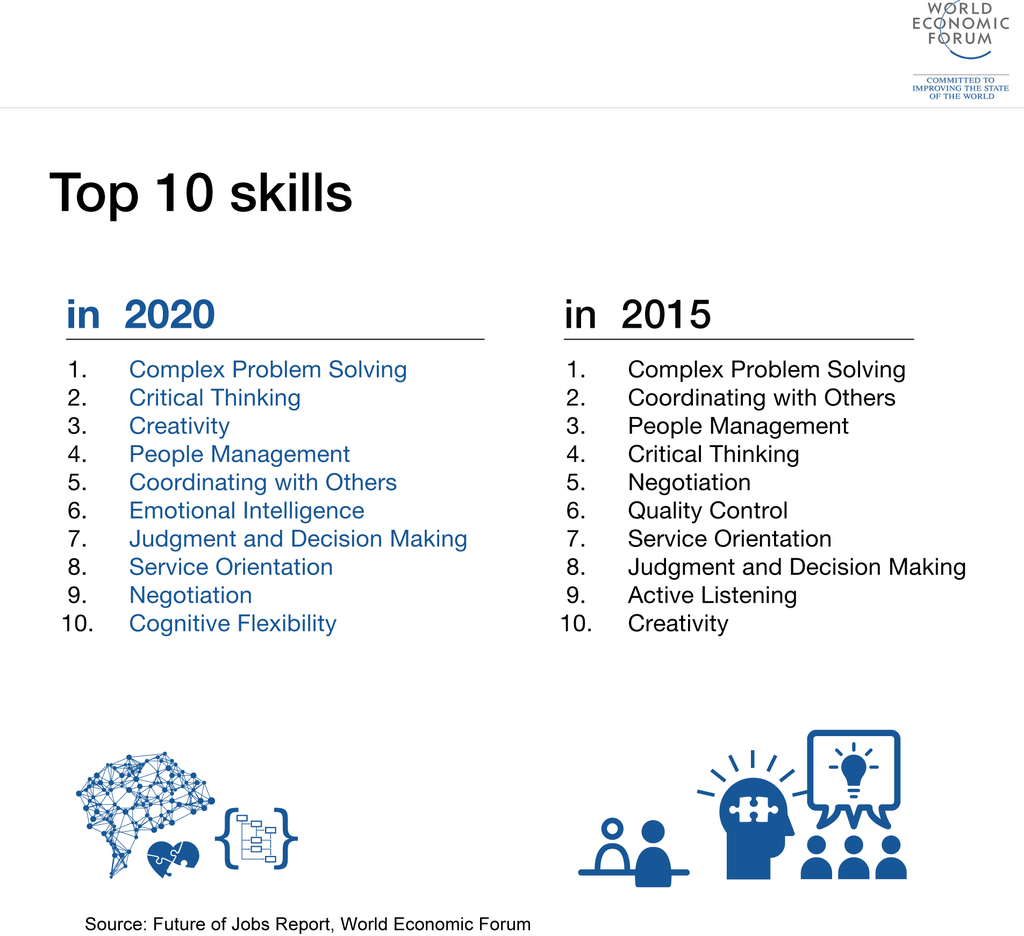
Yesterday I saw this image in the Huffington post 

Whilst searching for "top 10 skills for 2020" other lists emerged, not unsurprisingly suggesting other skills may also be important. I particularly liked this list from Top 10 online colleges


A believe a common enabler to implementing these skills has been omitted from both of these lists, and other's I visited, and that is managing change.

That is sustained change, required to develop and use these new skills, is only possible if hearts and mind's are engaged and that doesn't just happen. It requires that we be motivated to make the changes and, as I said yesterday, that requires that people be inspired - inside and out.

So before you start developing these skills, or recruiting for this *new* skill set, do make sure you understand how change will be embraced by these individuals, and how it will be managed and inspired going forward.

I'm attending #MentalHealthAtWork in Glasgow tomorrow, and was reminded by the notes from the last conference that 'reaction to change' is a major cause of stress. So too excessive demands, ineffective relationships and lack of: clarity on roles, control, and support. It's interesting, or perhaps I should say disturbing therefore, that skills to manage these didn't more significantly make it into the top 10!

What skills do you think will be in the top 10 for 2020, and where do you think change management (or even stress management) fits in?

You may also like Allison Ford-Langstaff's series of posts over on Future Purchasing's site that looks a little further ahead and ask's - what will procurement look like in 100 years time. Although my suggestion that we may no longer have any money never made it into any of her 3 lists - the seriously good, the disturbingly bad nor the slightly mad!

I've written other blogs on the enablers for team working, supplier management and category management because learning what to do differently, just as for any of the skills above, won't happen unless the enablers are in place.  No surprise that change management was included - so too many behaviours that would reduce the stressors mentioned in the last #MentalHealthAtWork conference. I'll be writing a blog following this year's conference - so watch this space.

Alison Smith
The Purchasing Coach
Inspiring change inside and out

Tuesday, 24 March 2015

EQ Summit (The leader's mind and its potential)


I attended the EQ summit in London last week and these are just my notes for future reference with links to other blogs/YouTube clips, and other references relating to the content and speakers.

I share it here for ease, and in case anyone else is interested too.

Although please note this is the conference seen through my filters - others attending may have taken something totally different away from the sessions.


So why all the fuss about EQ?

Leaders with EQ:
  • Bring out the best in others
  • Super charge the capability in the organisation and unlock 'discretionary' effort
  • Go with the human grain not against it
  • Have people working for them who are 3 times as likely to stay
  • Achieve extraordinary things as a result

The main sponsors/organisers and joint developers of the emotional capital report (ECR)
  • Roche Martin
  • Sheffield Hallam University
  • Sheffield Business School
10 elements of the emotional capital report, and therefore the building blocks of EQ are:
  • Self reliance
  • Straightforwardness 
  • Optimism 
  • Self actualisation
  • Self confidence
  • Self knowing
  • Relationship skills
  • Adaptability
  • Self Control
  • Empathy
With excellent graphic facilitation from @simonheath1 - whose website can be found here and also wrote a pre summit summary of who would be talking, and did a great job of selling the event (Simon was the only reason I found out about the event).


The Speakers

Welcome - Amy Bernstein - editor at HBR


Emotional Capital - the asset on the balance sheet you can't afford to ignore - Dr Martyn Newman - author and MD at RocheMartin
  • A great summary of a similar talk by Martyn, and a wonderfully animated video too, Emotional Capitalist - the new leaders.
  • Emotional Capitalists - the ultimate guide to developing emotional intelligence for leaders - Martyn's book on the subject
  • "We are profoundly connected to others and influenced by them"
  • He told a great story about Apple's business success over Sony - due to Apple's ability to collaborate and work together, and Sony's lack of emotional capital. Something I'm sure Sony regret to this day. 
  • Firms of endearment - a book on how world class companies profit from passion and purpose
  • Understanding values of ourselves and others is key (ie our motivators)
  • "What ever you find (when you look at yourself) you have to like"
"What lies before us and what lies behind us 
are but small matter compared to what lies within us. 
And when we bring what is within us into the world, 
miracles happen!" 


Better self, better leadership, better business
Jeremy Darroch - Sky CEO
  • "EQ potential super charges the capability we have and unlocks 'discretionary' effort"
  • CIPD article from the session - Empathy is the top leadership skill says SKY CEO 
  • "EQ delivers a high performing environment - rejects complacency and embraces the new"


Grant Thornton - leadership EQ's impact on revenue
Breakout with Anne Blackie and Jenny Kidby

Programme to introduce EQ across the business to move from technical experts offering solutions (often short term) to transformational leaders co-creating solutions (longer term too).

That is put the expert's ego to one side and bring our wholeness to work (the emotional and real person).


Motivation, performance and purpose
Dan Pink - author
  • "Reward of carrot and/or stick is outdated for the 21st century"
  • "3 main motivators - autonomy, mastery and purpose"
  • "Mastery - making progress in meaningful work" 
  • "Purpose - Making a contribution or difference"
  • "When asked 'tell me about your best boss' you never hear 'pathologically controlling' in the answer"
  • HBR article on purpose/how/why - trying to find what my notes meant on this - will come back when I know more, and if you can shed any light I'd much appreciate comments below - thank you
  • "Aim to tell people 2 less 'how's and 2 more 'why's" (links to the last comment)
  • "The profit motive can be an engine for good"
  • "You can go against the human grain, or with it"
  • Dan Pink's talk has been animated by RSA see 'Drive - the surprising truth about what motivates us', also his book on the same subject and HBR article.
  • Sukh Pabial's blog on the talk - Motivation, Dan Pink and EQ


Mindfulness for leaders
B Alan Wallace

Those that know me would expect me to already be into mindfulness and meditation. It's certainly the language I'm comfortable with. After all I've seen the Dalai Lama speak, and I even have the headspace app on my phone (even if I've hardly used it). 

However this is the first time I have EVER understood the benefit of mindfulness practices!  

The premise is - mindfulness helps focus attention at the same time as retaining a sense of ease. Which means after achieving this state of mindfulness we don't get stressed or strained when we do what we do afterwards. How wonderful is that!!

Or put another way - all our busyness, over attention or even boredom will stress our mind and body and therefore mean we're less effective - its also unsustainable for any period.


The alchemy of empathy - transforming stress into meaning
Eve Ekman
  • "There's a correlation between a lack of feeling of emotion in our body and lack of empathy with others"
  • "It's about emotional regulation"
  • Here's a video of a similar talk by Eve at the Mind and it's potential conference - cultivating emotional balance at work

Why the future begins - using EQ to optimise the future
Magnus Lindkvist

Sorry the last train north (and yes I mean very much north of Watford) was calling so I didn't hear Magnus speak. Tweets suggested he finished the day very humorously but I couldn't find any blogs or vlogs to link to - any suggestions most welcome.


As I made links to the content and my own passions I tweeted links to a few of my blogs:

Hope you found this helpful - I know I'll be back when I'm trying to recall what someone said, or to find that YouTube vlog.

Alison

Alison Smith
Inspiring change inside and out

I  did suggest on twitter half way through the session that this collage depicts life without EQ - ie without our humanness!


Wednesday, 18 March 2015

Decision Making: mind or heart?

I read with interest Tanveer Naseer's guest blog by Dianna Booher entitled 'Speak to the heart to lead change'. It certainly aligns with a previous post of mine entitled 'winning hearts and minds'.

The premise of both blogs is: we shouldn't leave our heart and humanity at the front door of our office - we need to take it in with us and use it. Particularly when motivating others - ie it is our values that determine what we will and wont do, and they are determined by our heart and emotions - not our mind and thoughts. If we want to motivate and engage someone therefore, we have to engage their heart to do that, and ours too.

However the assumption I made in my blog was the decision had been made logically (ie with our mind), and therefore to get support for it we now needed to use our heart/emotions.

During an exchange on twitter about the blogs with Ian Berry I was asked to consider making decisions from the heart (for those not twitter literate the conversation runs from the bottom up).


This blog is an exploration of that challenge.

When making decisions for myself I often rely on intuition/emotions to help me - for example:
  • Do I accept this or that piece of work, 
  • Do I go on this/or that holiday 
  • Which restaurant shall I go to
  • What dress(es) shall I buy :-)
  • Determining which question to ask coaching clients, and when to push forward, and when to pull back and so on.
  • To decide which house to buy. Although I did follow a more logical process to develop the possible options 10 years ago. So yes for me logic certainly seems to play more of a part in bigger decisions - even if the final decision was made on 'does it feel right'.
Use of my heart to make decisions therefore is something I'm very familiar with - but these are decisions I make on my own.

When I make decisions with others it feels like I need the logic to back up the intuition/emotion. I wrote a blog entitled strategies need evidence to suggest the same.

As a purchasing consultant I'm often faced with stakeholders using their heart and emotions to tell me why the current supplier is the best choice. If left to hearts alone we'd get nowhere fast - with everyone involved often preferring to stay with what they're already doing, and purchasing pushing for potentially new and shiney suppliers :-).

Often my role therefore is to help stakeholders understand why their heart's choice might not be the only option. This is achieved by uncovering the reasons (business requirements) their heart wants to stay with the current supplier, and demonstrating that alternative suppliers/options are also able to meet these business needs. (Although yes of course - sometimes it's about staying with the current supplier too).

That is Procurement follow a logical process to pull together the relevant facts and data. This in turn enables us to develop a strategy that meets the business requirements and also releases value to the organisation.

There are certainly times when heart may play a part in the decision making - with criteria for selecting options, and certainly selecting suppliers, often including - do we trust them, cultural fit etc.

Decisions are also checked against what our hearts feel. With our hearts' reservations being addressed by asking more questions and gathering more data. Because unless I can provide the evidence to support a decision how will I be able to convince the senior management of the efficacy of our strategy.

In summary our intuition and emotions can play a big part in decision making. It's generally used however to guide us to find more data to support our beliefs - in those instances where these beliefs are still counter to the current facts and data. (NB the more thorough your research and analysis the less likely you are to find a mismatch at the strategy development stage - ie all the hearts concerns and reasons are out on the table and have been addressed in the analysis undertaken)

I would love to hear your thoughts on this subject - in business can you easily use heart alone or does logic also play a part?

Alison

Alison Smith
Inspiring change inside and out - when what you're doing isn't working

Wednesday, 4 February 2015

Summary: Soft Skills


This week's summary blogs continue today with soft skills. I know it's an emotive phrase and I joined that debate with my blog rant last week entitled "but I don't do soft fluffy stuff" and went on to explain that we all do soft fluffy stuff every minute of every day - ie we're not the android above but human. I also wrote the case for soft skills too.

I first dipped my toe into understanding more about these skills over 15 years ago when I attended a 4 day NLP workshop. I was so enthused about the subject I went on to attend the remaining 16 days of the practitioner, a further 20 days for the master practitioner, another 20 days for the trainer trainer and numerous assistant roles to repeat all of the above. Which in class room time alone must amount to over 200 days on the subject. So yes I was hooked and books on the subject continue to arrive weekly as I explore the subject more fully.

Further certification in other coaching tools have just added to the melting pot of all things fluffy!  (More on these tomorrow).

I suppose that's why I blog so often about the subject - my enthusiasm for the subject - but also the ability as I blog to explore the models more fully. Recent blogging on the subject certainly helped when I included a lot of this content in Future Purchasing's Category and Supplier Management workshops before Christmas.

The challenge is how to summarise the blogs on this subject because they represent over half of the blogs I write. That said if I write on communication over a number of days I'll link to the other blogs from the final one. So that's what you'll have here - a set of favourite subjects with links to the main blog with the ability when you get there to explore that subject further. Although be warned its still a long list!


Change
Personal change management is at the heart of much of soft skills.
 

Values
Values are the key to much stuckness in our lives because they motivate our every action or not, and are the basis for how we judge others.


Influencing (Also see NLP with links to load of blogs)


Goals


Personal development


Wellbeing


My favourite quotes


Short stories I've written with wellbeing in mind


The summary blog tomorrow will share more about what I do and how I do it.

Yesterday I provided a summary list of blogs on procurement, and the day before a summary of rants on the loss of our humanity. A useful reference for those who enjoy my blogs and more easily want to read those from the archive - ok also easier for me to find them too :-).

Alison Smith
Inspiring Change Inside and out - when what you're doing isn't working

Tuesday, 6 August 2013

TALK TO THEM

The theme of effective communication continues - this time aimed at procurement functions.

A recent blog by Remko Van Hoek from PWC on HBR provided some interesting statistics around communication with procurement's internal stakeholders. These included:
  • only 51% of respondents gathering information on internal stakeholders
  • only 39% developing different stories for different audiences
  • only 27% having targets for stakeholder engagement
WOW - and then we wonder why our stakeholders don't use us nor appreciate the value the majority of us add!

They say actions speak louder than words - remember that's only if stakeholders:
  • feel involved enough to care
  • believe their needs have been met and concerns addressed
  • know the outcome of the actions we've taken
  • understand what was involved to deliver the outcome
For stakeholders to know all this procurement professionals need to talk to them. Previous blogs and Pinterest boards have touched on what form this talking might take and might include:
Remembering:
Until the majority of us start getting the basics right how can we expect our stakeholders to understand the great job we do and why we should be their internal supplier of choice for all their procurement needs.

What will you do today to improve your communication?

Alison Smith
Inspiring change inside and out

I use the meerkat picture because those meerkats' job is to keep guard and communicate danger. Without one of them undertaking that role they know that the whole group is in danger. They know they can't afford to let the basics be left uncovered.

A getting relationships right workshop has been arranged in August here in Scotland and can be delivered in-house within your organisation. It will address many of the issues raised in this blog and can be applied with specific stakeholders in mind.

Alison has a strong passion and energy for what she does which was demonstrated in her ability to run an innovative session for my team that identified what was holding us back from being a high performing team. This ability, when coupled with her capability to bring fun into the session, was a powerful tool for helping my team realise their full potential.” Cara Murphy, Senior Category Manager Lloyds Banking Group