Showing posts with label supplier relationship management. Show all posts

Monday, 21 May 2018

Garden full of suppliers

For over 20 years I've used gardening as a metaphor for supplier management. It was the foundation for Landscaping Your Life, a tool I developed and use in my coaching, where nature more broadly is used as a metaphor for life.

Why gardening?

Because many of our internal stakeholders, especially those in the UK, know more about gardening than they do about supplier management.

They know that lawns need mowing.


Lawns also need weeding,


along with many a flower bed (or is it just mine?),


and the odd wall.

The power of the metaphor is realising suppliers also need mowing and weeding - just like that long tail of suppliers that needs to be reduced.

Plants also need pruning, whether it's to ensure they flower again this year,


flower again next year,


or to ensure they're fit for the purpose they're in the garden for anyway (ie like this rhubarb that once it's bolted it is too late to save it for this year's crumbles and pies!)


That's the purpose of supplier contract, risk and performance management reviews. Checking that suppliers continue to meet the needs of the business, and haven't expanded their remit into areas they're not supposed to be in, or clearly have no expertise on.

Sometimes plants/trees need chopping down as they're no longer providing fruit, and have died.
Like those Suppliers whose contract expired years ago, or that keeps getting extended, when no one is really sure what they do, nor value they deliver.

There are plants that are just coming into flower,


plants that continue to flower over a wide period of time,


plants that are just about to flower,


plants that open and close with the sun,


plants that will flower much later, 


and plants that never flower - and are there for their decorative leaves.


Always room for a picture of a cat me thinks, who accompanied me around the garden whilst taking my pics.


Remembering that each supplier has been chosen to meet different business needs. 

Each supplier also with their own needs, some needing time in the greenhouse before planting out (especially here in Scotland),


others more frequent watering,

feeding, or support.

The challenge in business is, that many managers treat suppliers like the tree planted in the corner of the garden, left unmanaged and forgotten with roots that are now undermining the very foundations of the house. Oblivious to how their own behaviour supported the undesirable outcome.

What attention do your suppliers need, and when will you give it to them? 

More analogies between gardening and supplier management can be found on this Purchasing Coach Pinterest board. There's also a number of video blogs on the subject over on a Purchasing Coach playlist.


Watch out on the Purchasing Coach Twitter, Facebook and Instagram this week for insights arising from Chelsea flower show #RHSChelsea that can be applied to supplier management.

Alison Smith
The Purchasing Coach
Sowing seeds for effective supplier management.

Monday, 14 May 2018

Mental Health in Procurement

Just as we all have physical health, we also all have mental health. 

A conversation about mental health is however never as easy as one about physical health. Initiatives such as #MentalHealthAwarenessWeek aim to rectify this oversight. 

In support of Mental Health Awareness Week I'd like to invite you to consider what you're doing to support your own, your colleagues' and even your suppliers' mental health.

Over on my Landscaping Your Life blog this week I explore that one place in nature that helps me find balance for mind, body and soul - the local beach here in Scotland as shown below:  
In that post I ask you to consider what landscape keeps you mentally healthy? (Having a landscape that supports me when I'm out of balance is on my prescription for positivity that I refer back to in times of need.) 

Other posts over recent years where I've explored mental health at work include:
  • That's just the way business is - my plea to bring our humanity to work with us, and not to condone unacceptable behaviour and hide behind "That's just the way business is".
  • Let's talk about it - notes from attending a HeadTorch conference on changing attitudes towards mental health at work.  
  • It's not about the Toast - notes from an earlier HeadTorch conference where a piece of interactive theatre (HeadTorch's USP) highlights the need to be aware of what's really going on.    
  • Dear Human Being, with love from your Mental Health - a post card sent from our mental health. What would your post card say? And more importantly, would you listen to its advice? 
  • How's your suppliers' mental health? A reminder of the stereotypical behaviours buyers exhibit that can have a dramatic and negative impact on suppliers' mental health.
  • A Postcard, with love from your Supplier's Mental Health exploring the six key areas that the HSE say cause stress, and exploring what buyers can do to avoid increasing stress in suppliers in these six areas. 
  • Are you a toxic leader? Not something anyone would put their hand up and admit to, and yet something I'd suggest is too easy to slip into in business, and often found where we hear "that's just the way business is".

The first of these posts says it all for me - we're human beings with continuum's of mental, physical and spiritual health. Denying our humanity, and leaving it at the office door, means these continuums are frequently compromised. Burying our head in the sand and denying their importance is counter intuitive, and is not the means of achieving a flourishing and sustainable business. 

We have a choice - ignore mental health at work and hope for the best, or embrace it's importance and ensure our actions support personal and organisational flourishing.

What can you do today to ensure your actions support mental health at work? 

Alison Smith
The Purchasing Coach
Supporting mental health at work

Sunday, 21 May 2017

Benefiting from the Fruits of your Labours

RHS Chelsea flower show is here, and with it the art of the possible.

Every year about this time I think about growing my own vegetables. I think about how lovely it would be to eat the fruits of my labour later in the year. I dream of freshly picked green beans, beetroots straight from the ground, and picking ripe juicy raspberries from the bush. I imagine the recipes I could use, and the wonderful meals I could cook with the home-grown fruits and vegetables. The fun and laughter with the friends I’d invite to share in the delights of my garden.

Then reality sets in as I watch my neighbours as they spend hours I don’t have, nor have the motivation, sowing seeds, carefully putting them in the greenhouse, watering then daily, pricking out and thinning the seeds as they grow, repotting them, and then feeding and generally putting a lot of time and effort into their own fruit and vegetable plots.

When I told Terry, the guy who mows my lawn, of my plans he smiled sweetly as he recalled all the times he’s had to tell me he’s going to prune a bush, or set about the garden to weed it after it’s got very overgrown.

Isn’t that the same in many organisations? Not for fruit and veg but for our suppliers? We have high hopes and expectations of our suppliers, and yet we, and our organisation, are not prepared to put in the effort needed to bring forth that bounty?

If we expect suppliers to do it themselves without our support and assistance then we shouldn’t be surprised if we end up with an overgrown lawn, a tree whose roots are busy undermining the house’s foundations, plants throttling other plants, or plants that have died through lack of water.   

Many of the horror stories of procurement gone wrong can track their origin to suppliers left to fend for themselves, or inadequately cared for. 

Who in your organisation is responsible for tending for your suppliers, and will the fruits of their labours meet organisational expectations in the autumn?

Gardening is a metaphor I often use with non-procurement managers as it’s something they can relate to more easily than the process we enthuse about and understand intimately. This post explores the metaphor further, and I’ve also pulled together a Pinterest board exploring different aspects of the metaphor.

Alison Smith
The Purchasing Coach
Unlocking Procurement Potential using Unconventional Tools 

Friday, 25 November 2016

How could pipe cleaners have the answer?

During a recent half day Procurement Innovation and Creativity clinic via webex, to a group of three people over in Atlanta, someone mentioned they'd attended a workshop where they'd used pipe cleaners to introduce themselves.

As anyone who knows me well will understand it wasn't long before I had 500 multicoloured pipe cleaners on the way to me, with a desire to find a means of using them at the next workshop.

Whilst I love unconventional tools, I will only use them if I think they align with the intention and goals of the workshop, and support the learning outcomes. Which meant I hadn't quite got my head around how I'd use them on the supplier management workshop this week in Warsaw.

However the delegates were keen to understand different ways of resolving problems with suppliers and so I found myself uttering the words "let's try the pipe cleaners". 

I then asked them to use the pipe cleaners to represent the current unsatisfactory situation they wanted some insight on, and then to do one for the best possible outcome. 

One result looked like this:
Which became this:

Or this: 
Became this:

or the bottom structure became the top for both of these examples


I could continue - but assume you get the idea.

I then asked them in turn to describe the difference between the two sculptures - these are the notes I made at the time:

The words used to describe the 2 sculptures certainly seemed to contain the kernel of an idea within them. Ideas that, whilst perhaps not revolutionary, had hidden close to the surface of their owners subconscious only able to be expressed via the sculptures that had been developed.

We discussed the potential solutions that were emerging as a result. What I then asked the delegates to do was identify actions they could take as a result of the guidance provided by these sculptures - or even sculptures others had developed.

One insight for me was about our ineffective use of the words 'needing to improve communication'.

Unconventional tools certainly have their place when the solution is eluding you, and they can certainly speed up the process to achieving resolution.

If you're struggling with a problem what tool can you use to bring forth the very solution that's thus far hidden from you?

Alison Smith
The Purchasing Coach
Inspiring Change - inside and out 

Some of the other unconventional, yet effective, tools I use in workshops and coaching include: 
Follow hypertext links to previous blogs on the subject highlighted.

Sunday, 26 June 2016

Assertive or aggression?

I've been told many times over the years that if I stick with eating hot spicy food I'll eventually be able to tolerate, and even enjoy it. One lodger even used to throw a few chillies onto my half of the pizza in an attempt to expand my palate.

I've never yet managed to get beyond the numb mouth, and lack of enjoyment for the rest of the meal.

Some might say perseverance would get me there, but I doubt it.
Last night I went to see Independence Day: Resurgence - which had a 12a classification which suggested that it contained scenes with mild violence. Like the lodger throwing chillies on the pizza the movie had violence thrown in that, instead of sensitising me to the violence, had me closing my eyes until the scene was over. 

I shouldn't have been too surprised as many programs I once enjoyed with 'mild' violence (Doctor Who, Star Trek and SG1) I now find too violent. (Any sci-fi recommendations with minimal violence most welcome).
What I've come to understand is I'm getting more and more sensitive to spicy food and violence. That is, perseverance doesn't seem to have made me less tolerant of spice or violence but more sensitive to it.

It would seem like many things spice and violence have an analogue scale not a digital one, and one that can change over time. 

The problem comes when we try to attribute values to the scale - after all where I'd put mild, medium, hot, and very hot would be in very different places on the axis to my spice loving lodger, and to other Indian meal loving friends. (And no there is not an Indian meal that my palate would describe as medium never mind mild - they are all HOT!)

On a supplier relationship management workshop this week two of the models discussed had 'level of assertion' as one of their axes. In both models the axis being discussed went from unassertive or passive to assertive. 

In the session we discussed that the scale doesn't necessarily stop at assertive - it's a bit like saying it stops at medium spice. The missing piece to that scale is when assertion becomes aggressive, or very very hot. 

On a Google search I like this interpretation of the scale:


Just like spice or violence what we perceive as aggressive will, however, be open for individual interpretation. Even the words used to describe each of the above perhaps say much about where the person writing the words feels comfortable. 

That is my passive could be your aggressive! So where does that leave us? 

The topics we covered on the workshop last week suggested strategies might include: 
  • Understanding your own perception - values and beliefs.
  • Standing in the shoes of other people we're working with and understanding their perception, values and beliefs.
  • Not judging the other person as wrong just accepting the difference.
  • Taking responsibility for the reactions/ outcomes others have to our behaviour.
  • Understanding whether what we're doing is moving us away from or towards our short, medium and long term goals.
  • Adapting our style to suit the people we're dealing with, and the outcome we're wanting.
Next time you say something is "mild" and the other person is telling you it's "much too hot" you may want to stop stop and consider which of the above strategies would help find a happy "medium". Without that "medium" being overly accommodating, competitive or manipulative.

Or of course you could keep pouring water on to hot oil - just don't be surprised if someone gets burnt! 


Alison Smith
Inspiring Change - Inside and out 

Monday, 1 February 2016

How's your supplier's mental health?

I recently attended Let's talk about it - changing attitudes towards mental health at work. A conference that reminded us all of the benefit of talking more about mental health.

You'll see from the blog the different ways we were being encouraged to speak about mental health.

It got me thinking about talking about mental health with suppliers.


For example when did you last ask a supplier's representative:
  • Are you okay?
  • What can we do to help? 
  • Which of our behaviours are negatively impacting the mental health of you, or others within your organisation 
  • What could we do more of? 
  • What should we do less of?
  • What shall we keep doing?
Or shared with them how their behaviours are impacting the mental health of those within the buying organisation.

It's so easy to talk in terms of orders, invoices, contract terms, service level agreements, key performance indicators, and forget we're often just human beings dealing with other human beings.

Human beings with mental health that can either support their ability to do their job or not!

In the blog "But I don't do soft fluffy stuff" I tackled, even if perhaps a little too vociferously, my belief that we're all human beings and not androids. This belief is the reason why I believe procurement has a responsibility for ensuring it doesn't abuse it's power, nor push supplier's to break point. Especially when we hear stories of many people broken due to Tesco's, and other organisations', behaviour with respect to payment.

It's too easy I suspect to say "I wouldn't do that!", and then move onto the next blog, and forget all about the question.

I am sure my actions over the years, however unintentional, have negatively impacted others. Should I just think "Tough! I was just doing my job" or "I wonder how I can do this differently now and in the future?"

Not an easy quandary to answer - especially when many organisations aren't even talking about, nor considering, the mental health of its own employees - never mind those of other organisations.

Other blog's written along the same vein include:
Do you think it's procurement's responsibility to consider our impact on a supplier's mental health? and they yours?

I'd love to know your thoughts - do leave comments below.

Alison Smith
The Purchasing Coach
Inspiring change inside and out - and here's why I think inspiring change is important and necessary if you're wanting sustainable change for the future

Friday, 15 January 2016

Supplier Relationship Management or just Relationship Management

On a recent workshop, during a conversation about the meaning of Supplier Relationship Management, we realised the words used are very prescriptive and not at all inclusive.

As I shared earlier in the week we felt the supplier (red), procurement (blue) and internal stakeholders (green) would all have different interpretations for what the words meant. Interpretations that might not necessarily inspire the desired action from those involved.

Our recommendation on the day therefore was that we refer to the activity of managing buyer/supplier relationships as Relationship Management.

I realise that may beg the question - what relationship - but at least it enables the responsibility for the relationship to be shared. After all marriage guidance isn't called wife guidance or husband guidance - as much as either party might like it to!

Alison Smith
The Purchasing Coach 
Inspiring Change Inside and Out (more here on why that's important)

Wednesday, 13 January 2016

What's in a word - Procurement

Rarely a workshop goes by that I don't get everyone up on their feet and sharing the words they associate with the word Chocolate.
That is helping those there to understand that it's very easy to miscommunicate, even when using simple words like chocolate.

The reason for using the word chocolate is it reinforces that we're on a very sticky wicket when we use words like procurement, category management, supplier management or supplier relationship management. That is the chances of having a common understanding with other stakeholders is negligible. Yet we often forget this fact, and make other assumptions about reactions we're getting to what we're saying.  

On a recent workshop I asked the delegates what they thought the definition for Supplier Management was for 3 different groups - see their response for Procurement (blue), internal stakeholders (green) and the supplier (red).

As you can see they thought Procurement defined supplier management very positively, internal stakeholders with a degree of fear, and suppliers negatively. Whether their assessments are correct is open for debate. Even so it provides further insight into the challenge of adopting Supplier Management in an organisation.   

To find out more about the content of recent workshops follow the links for category managementsupplier management and team building. A lot of the focus of the blogs are on the soft skills required to do the job well rather than the procurement processes to follow.

Tomorrow I'll share a recent example of miscommunication, and the use of the words 'personal care', in the NHS!

Alison Smith
The Purchasing Coach
Inspiring change inside and out  (more here on why that's important)
+44 (0)7770 538159

Saturday, 28 November 2015

Enablers for Supplier Management

When delivering category management or supplier management workshops I often find myself saying "I wrote a blog on that". Last month I provided an index of the blogs that I mentioned during a Category Management workshop. Today I'm sharing the blogs that refer to content covered in a recent 3 day Supplier Management workshop (and updated to support learning covered in subsequent sessions in 2016.)

As ever the blogs seem to concentrate on the enablers for effective working rather than the procurement tools and techniques covered in the workshop. And yes there's a degree of similarity in the index between Category Management and the Supplier Management workshops - not because the procurement tools were similar - but because soft skills, change management, communication, influencing and creativity are common enablers, and are all skills requiring development and use in all aspects of procurement activity. 

The Enablers (in no particular order - and I'm not expecting anyone to want to read every blog - just any that either pique your interest as you read the title - or for those who have attended the workshops - topics you wanted to explore further)
Some of the unconventional, yet effective, tools we used or spoke about
Supplier Management - because I do write some processey blogs
Future blogs that I would like to write following discussions during the workshop(s) include:
  • Problem reversal - a great technique for problem solving.
  • What's in a word - would relationship management be a better term than supplier relationship management? See picture for what we think the 3 different interpretations of 'supplier management' might be dependant on whether we're procurement, a supplier or an internal stakeholder. 
  • The language of stick and carrot - because we need to be consciously aware of which of these we're using.
  • The link between mind, body and emotions.
  • More on organisational and personal metaphors and the words we use for each (exploit, attach, fight, war, threat and enemy are words that work well for those operating a war like metaphor, but won't work with someone who operates a nature like metaphor for their life).
  • Use of pipe cleaners to solve problems!?!
For other more procurementy or businessy blogs I've written please see this index

I also mentioned a few of my rants during the session, and an index of all my rants can be found by following this link (The common theme seems to be the lack of humanity with which we often treat each other!)

Alison Smith
The Purchasing Coach 
Inspiring change inside and out (more here on why that's important)

Friday, 20 November 2015

How attractive are you to suppliers?


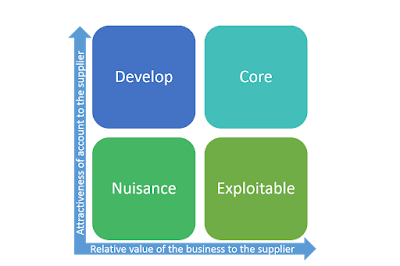
In the majority of procurement literature, workshops and exams buyers are asked to consider the above 'supplier preferencing' model. It identifies 4 potential ways a supplier can 'view' the buying organisation. 

As with many business models it's value is delivered from the conversation that arises. A conversation that helps us understand how our suppliers, and we as the buying organisation, might relate to it. It involves the buyer considering:
  • How attractive they think they are to a supplier
  • How attractive they might really be - if they consider the behaviours they're experiencing from a supplier
  • What behaviours suppliers might consider to be attractive - remembering each supplier will be different 
The premise is: a supplier who sees your account as highly attractive, AND as contributing a larger share of their sales is likely to see your account as Core. With the same level of attractiveness, but smaller percentage of sales, it becomes an account they would like to Develop. The potential problems arise when an account isn't very attractive - with the resulting potential for either Exploitation or being treated as a Nuisance dependant on the relative value of the sales.

The main reason for using this model in workshops is to invite buyers to consider the behaviour they may be demonstrating that might be seen by a supplier as unattractive, and therefore is very likely to be contributing to less than helpful behaviours from the supplier. Or, if they aren't doing currently, might do so in the future. 

In no particular order the unhelpful buyer behaviours suppliers may see as unattractive include:
  • Squeezing profitability  
  • Late payment to agreed terms
  • Extending payment - see my rant on 'who owns payment terms' directed at CFO's who forget it's part of the contract that buyers agree with suppliers - ie not something Finance should alter at whim!
  • Always doing the opposite to what's been agreed
  • Changing minds, and expecting the supplier to pick up the impact re costs, timescales etc
  • Too many people involved - different people telling suppliers different, and contradictory things
  • Not being paid for extra costs - irrespective of the original agreement  (see point above)
  • Overly bureaucratic 
  • Lateness - for meetings, information, orders, feedback, changes and so on 
  • Using suppliers to benchmark prices, and having no intention of changing supplier
  • Inaccurate or limited forecasting
  • Difficult to work with - behaviourally or personally 
  • Arrogant 'you need us' behaviour and language (linked to the above point)
  • Bullying - see two related blogs on the subject Don't turn a blind eye  (to unacceptable business behaviours) and Are your supplier afraid to say no?
  • Disrespectful behaviour - see do your suppliers' sleep at night blog?
  • Unethical behaviour 
  • Continued lowest price focus - irrespective of potential for cost and value benefits
  • Lack of appreciation - so easy to forget that a Thank You is appreciated even if "they are getting paid for it". (Most buyers get paid for what they do and expect thank yous and recognition from their manager and those they work with - why think suppliers don't!)
Consideration is also given to what behaviours might be considered attractive - many of which are the opposite to the above.

Yes sales is attractive, but this model is asking buyers to consider what might detract from the value of the sales, and mean the buying organisation's needs are not as important to the supplier as we would like them to be.

I think the above model misses an additional strategy - and that is a supplier could simply walk away


It's a strategy a supplier has irrespective of turnover, but certainly something they're more likely to consider if the account is becoming increasingly unattractive. This is a point I often find myself disagreeing with other buyers and colleagues about - the assumption that any sale is better than none. I believe for every supplier there will be a point where the level of unattractiveness means a supplier will decide the best option is to walk away.

When sharing the model in workshops we often use the metaphor of personal relationships. With first dates, dating, marriage and divorce being mentioned. We've all known people who have stayed in a relationship well past its sell by date, and as a consequence their health, well being and sometimes financial health are compromised. It's no difference with suppliers - there will be a point - if pushed to far - when they say "enough" and walk away.

Assessing power between a buyer and supplier can only take you so far. Once someone's values such as respect, honesty, integrity and fairness are being compromised you'll be surprised what people are willing to do despite the consequences. (My blog 'Ethical behaviour comes with integrity' also discusses what people are prepared, and not prepared to put up with as a result of their values).

I would love to know your thoughts - as a supplier have you walked away when everyone else would expect you to stick around, and put up with what you believe to be unacceptable behaviour. As a buyer have you been surprised when a supplier has made the decision to just walk away, and what were the reasons given.

For blogs on other topics covered during procurement workshops see blog entitled I've written a blog on that.

Alison Smith
The Purchasing Coach
Inspiring change inside and out (more here on why that's important)

Sunday, 2 November 2014

Influencing: Suppliers are people too

Recent blogs have focused on influencing and to be fair most of the examples I've given have implied these techniques are to be used with internal stakeholders. The assumption being you don't want to fall out with these stakeholders, you do need to influence them and therefore here's the things to think about when dealing with them.

One response to one of the blogs this week via twitter said

"wise words - purchasing tends to make us combative in achieving goals,
which doesn't lend itself to internal influencing". 
 
 
Which made me realise I'd not emphasised perhaps enough how much I use all of what I'm blogging about with suppliers. In fact I'd say its my point of difference in how I deal with suppliers. That said I don't tend to spend lots of time negotiating the commodity leverage categories. 

Supplier's representatives are people and as such they have preferences for how they process and take in information just like you or I do. So if you're wanting to influence them why wouldn't you want to consider how to do that in the most effective way. Of course a combative approach has its place but that can lead to resistance and that may or may not work for you.

Personally there's very little difference between how I treat suppliers and how I treat internal stakeholders. That said I'm usually developing a strategy along side the internal stakeholder and wanting to impose it on a supplier. So yes my goal may be clearer and less likely to change when dealing with suppliers than when dealing with internal stakeholders. I can however still flex my style to enable suppliers to understand my position more clearly - after all "No!" and "Lower!" don't always provide much information to help suppliers amend their position.

Do you use different influencing styles with suppliers than internal stakeholders? Is that always successful and if not how might you want to flex your approach to see if you can achieve a different outcome? 

Alison Smith
Inspiring change inside and out

Wednesday, 29 October 2014

Trust is in the eye of the beholder

I remember having a conversation with a colleague 6 months after the Halifax merged with the Bank of Scotland.

"You meant everything you said when we merged" they said to me.

I was a little taken aback - of course I meant everything I said - why wouldn't I and, perhaps the biggest surprise for me at the time, why wouldn't they have believed me.

At some level their response says more about the culture they were in at the time than is does me. However it also demonstrates that trust takes time to build.

We might know ourselves to be trustworthy but how do we demonstrate it to those we work with and those we wish to influence - whether internally or externally.

In Stephen MR Covey's The speed of trust he believes 'self trust' is needed before we jump into trying to achieve 'relationship trust'. Which of course makes sense - we have to be credible before we can expect others to trust us.

Self Trust

Covey identifies 4 keys of credibility that can be categorised into credibility of Character and credibility of Competence.

Integrity
  • Make and keep commitments to yourself
  • Stand for something
  • Be open
Intent
  • Examine and refine your motives
  • Declare your intent
  • Choose abundance (perhaps more of this on a future blog)
Capabilities (Talents, Attitudes, Skills, Knowledge, Style)
  • Run with your strengths
  • Keep yourself relevant (perhaps something I could learn for my blogs :-))
  • Know where you're going
Results (Track record) (one I consistently forget to convey to others - although I have updated my linkedin profile to try to address this :-))
  • Take responsibility for results
  • Expect to win
  • Finish Strong
Relationship Trust

Covey identified 13 behaviours * needed to develop and maintain relationship trust. As you read through the list how many of these may be contributing to your lack of influence with those you're currently working with?
  • Talk straight
  • Demonstrate respect
  • Create transparency
  • Right wrongs
  • Show loyalty
  • Deliver results
  • Get better
  • Confront reality (wonder if you can do this too much - see latest rant on confronting unacceptable behaviour in business!)
  • Clarify expectations
  • Practise accountability (blog to follow on slopey shoulders)
  • Listen first
  • Keep commitments
  • Extend Trust 
In those first 6 months of the Halifax/Bank of Scotland merger I certainly believe I demonstrated the 13 behaviours. I wonder however if I'd spent a little more time building and demonstrating my creditably earlier on if it would have been any easier?

Trust is often seen as something you either have or don't have and forget that it's in the eye of the beholder, and therefore more action is sometimes required to demonstrate our trustworthiness to others.

What about you - any ah-ha moments?

Alison Smith
Inspiring change inside and out and demonstrating trustworthiness in all that I do

* This has been a very academic (for me anyway) statement of Covey's model. Whilst this week's blogs will be expanding on the subtleties of influencing blog, in November I will bring alive the 13 behaviours mentioned above using good, and not so good, real life examples. Any contributions most welcome alison@thepurchasingcoach.co.uk